




Stirling has been named one of the top places in the UK for house buyers to haggle down property prices.
According to new research from legal software provider Access Legal, buyers in Stirling are securing average discounts of nearly 30 per cent on asking prices.
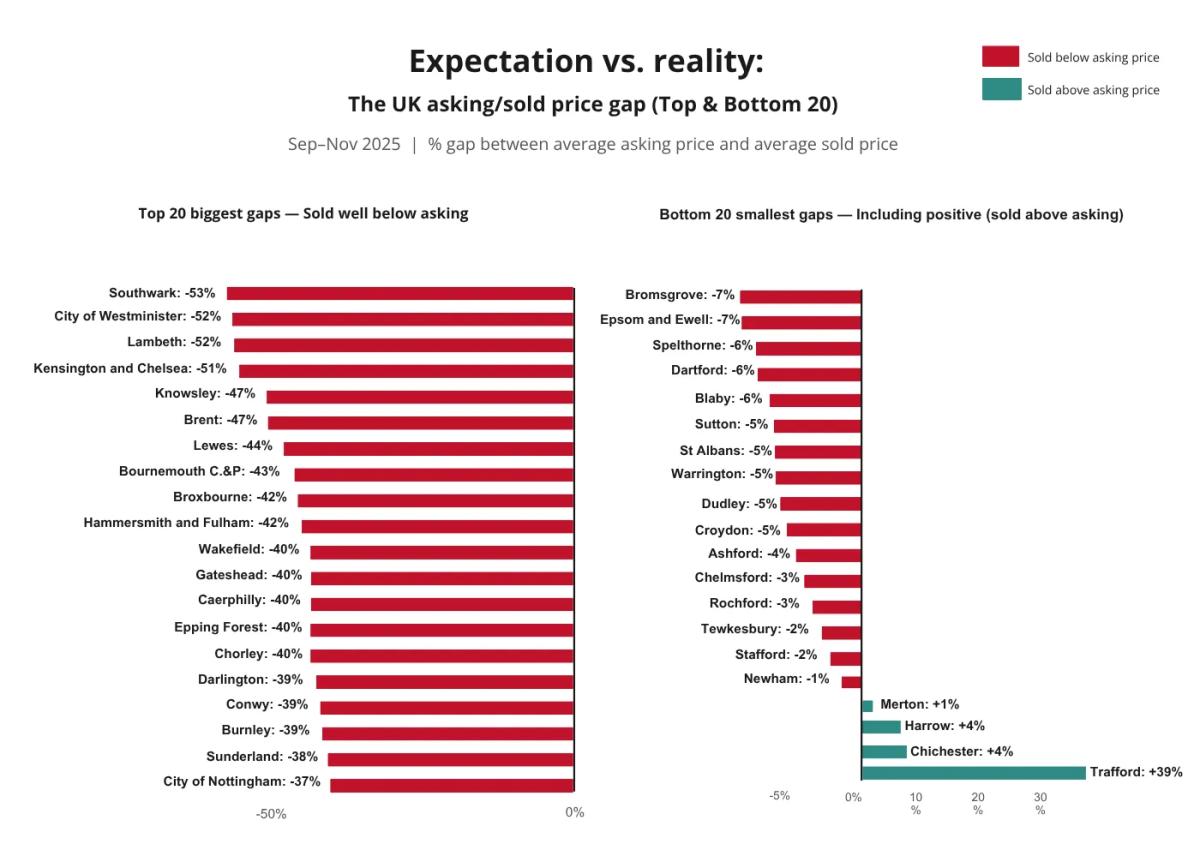
The study compared asking and selling prices between September and November 2025, and considered affordability, energy efficiency, and chain dependency.
Robin Edwards, managing partner at Curetons and a real estate professional with over 20 years of experience, said: "The gap between asking prices and final sale prices we’re seeing across the UK comes down to a lag between seller expectations and the financial reality buyers are working with now.
"Many sellers are still anchored to pre-2022 valuations when cheaper borrowing significantly increased what buyers could afford.
"Today with mortgage rates higher and affordability tighter, buyers simply can’t stretch in the same way.
"For buyers this environment creates an opportunity to negotiate more confidently, particularly where a property has been on the market for a while or requires a lot of work.
"Buyers who are financially secure, chain-free and able to move quickly are in a particularly strong position because sellers are increasingly prioritising certainty over squeezing out the very last bit of price."
Access Legal’s research identified Stirling as a top location for buyer-friendly negotiations, with an average selling price of £229,572 compared to an average asking price of £320,967—reflecting a 28.47 per cent "discount gap."
The study developed a "buyer power score" for each location based on four key factors:
1: The size of the discount gap
2: Affordability in the local market
3: Market velocity (how quickly sales are completed)
4: The prevalence of poorly rated energy efficiency properties (EPC Lever), which can be used as a bargaining tool

Stirling ranked 21st out of 161 UK locations, earning a buyer power score of 68 out of 100.
The wider trends point to a rare period in the UK housing cycle, where buyer affordability and seller expectations are at odds.
This deadlock began in late 2022, when mortgage rates surged from around 2 per cent to more than 6 per cent, sharply reducing what buyers could afford at a time when house prices remained high.
The Bank of England held the base rate steady on March 19, with little sign that mortgage rates will fall substantially in the near future.
Unlike the 2008 financial crisis, which saw an immediate collapse in access to credit, the current market is experiencing a slower, more gradual correction, similar to the early 1990s, when high interest rates severely limited affordability.
However, today’s sellers generally have sufficient equity to accept lower offers, which was not always the case during previous downturns.
Mike Connelly, Head of Commercial, Conveyancing at Access Legal, said: "Standard housing indices that rely on asking prices are currently painting an incredibly misleading picture of stability.
“We developed this research because buyers, sellers and legal property professionals need to look past the final asking price to really understand what’s happening between homes going on the market and what they eventually sell for.
"That 22% average void isn't just a standard negotiation margin; it represents the harsh mathematical reality check that is hitting the market.
"We are witnessing a slow correction of the UK housing sector, and with mortgage rates going up once again, this correction is going to last for a good while yet.”
For a full breakdown of asking price and sale value gaps across the UK, the complete dataset is available on Access Legal’s website.


Share